A 17-year-old emerging female sprinter weighs 64kg. Given her training age, she is quite powerful in a traditional sense and relative to elite standards. Here's her profile with field-based standards and tests:
1RM Power clean x 70kg (1.09 x BW). Elite female sprinter standards are ≥1.3-1.4 x BW
Standing double hop (2 leg take off/hop/hop/ 2 leg landing) symmetrically 7m each leg. Elite female sprinter standards 7.45m
1RM BB Back squat x 115kg (1.8 x BW). Elite female sprinter standards are ≥2 x BW
In terms of laboratory-based testing (on force plates):
1RM Smith Machine Concentric Jump Squat with 60kg saw her produce her highest power of 2950 watts (46w/kg)
Olympic lifts, such as power cleans, have always been a proven and trusted means of developing mechanical power in speed athletes. High levels of relative mechanical power are critical to sprint block start performance.
A concentric jump squat in a smith machine on force plates offers more resolution and reliability as an assessment of mechanical power. A power clean and jump squat mimics the triple extension action required when accelerating from a stationary start.
Standing triple jumps and standing double hop tests have long been used to test and train specific leg power for acceleration. Assessing each leg independently via hopping offers insight into symmetry – both in terms of coordination and leg power.
However, none of these training and testing modalities are sprinting, which is a whole-body movement occurring in all 3 planes. Furthermore, good acceleration performance requires concise coordination of all 4 limbs and where the spine and pelvis act as anatomical levers.
The DynaSled
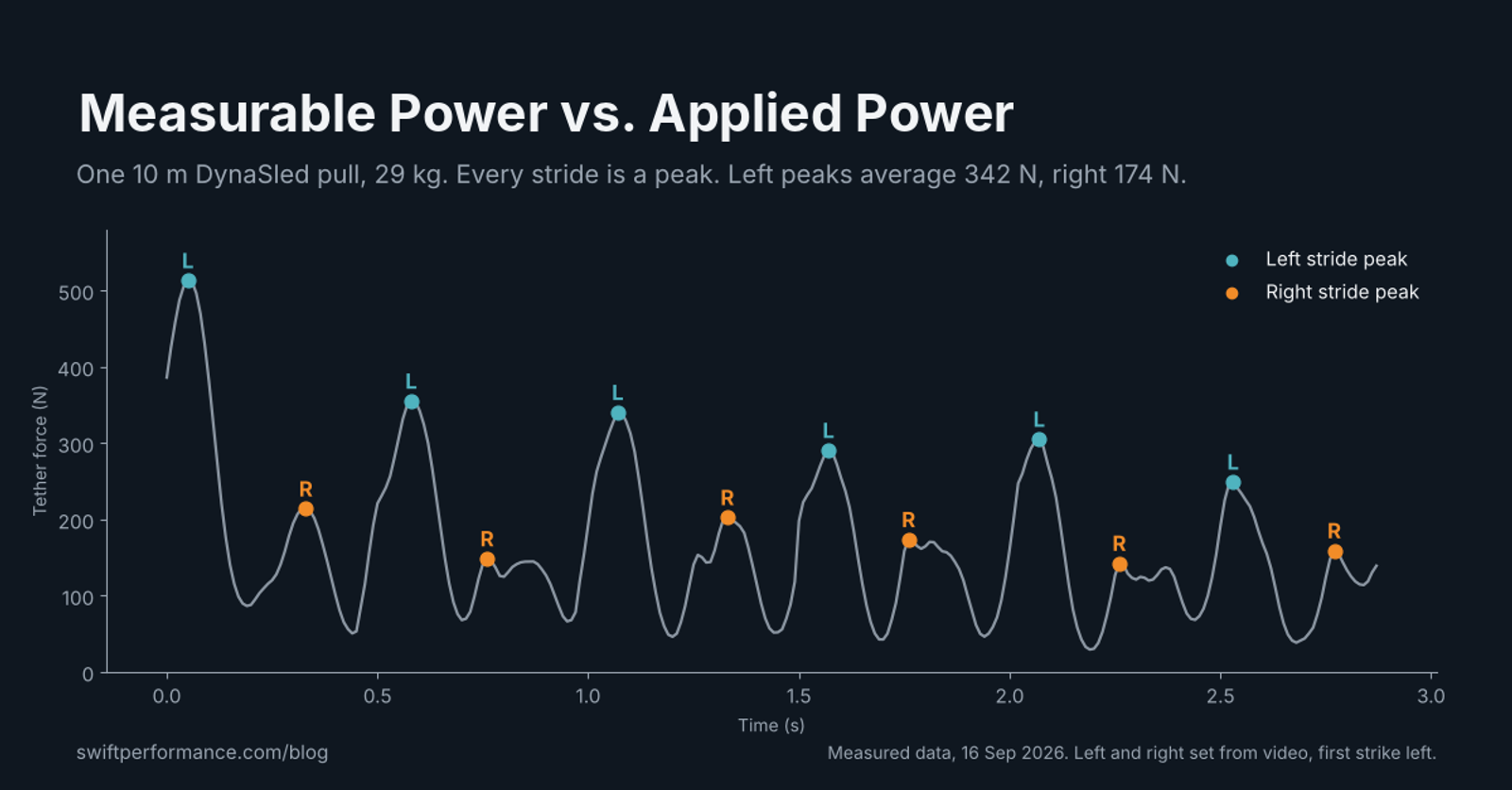
On 16 September the athlete did a 10 metre acceleration on a DynaSled with 29 kilograms on the sled. The load cell reads the force in the tether between her and the sled, and every stride shows up as a peak in the trace. Look at the peaks and the pattern is obvious (figure 1, at the top of this page). Big, small, big, small, all the way down the track. One leg is doing about twice the work of the other. Left strides averaged 342 newtons. Right strides averaged 174. The rate at which she built force followed suit: 2,904 newtons per second on the left, 1,443 on the right. The right was lower on all six pairs of strides, about two to one on average.
How we know which leg is which
I want to be straight about this, because it matters. The DynaSled load cell reads the combined force of both legs through the tether. On its own it can't tell a left foot from a right one. For this run we filmed the athlete and lined the video up with the force trace in an analysis tool. Her coach confirmed from the footage that her first push was off the left foot. A simple rule then picked out each push from the rate of force development: a rise only counts as a push if its peak reaches at least 30 percent of the push before it. That kept 12 real pushes and dropped two small noise blips, and every one was checked frame by frame against the video. From there the pushes alternate, left, right, left. Doing this automatically, inside the product, is something we're developing. It isn't there yet, and I won't pretend otherwise.
What's causing it?
The coach reviewed the footage stride by stride. His read: "Her left arm is too passive and not coordinated and timed with the force application of the left leg. Therefore, because the left arm doesn't offer counterbalance in the sagittal plane, the right leg touch down is a block. Meaning the left leg is behind on touchdown of the right leg. In plain English, it is overstriding. Running mechanics is the issue here - not a strength problem. Her right leg isn't weak. Whilst not as pronounced, this technique flaw appears when the athlete accelerates without the resistance of a sled. The sled simply amplifies the error."
A Jump Squat would not show this asymmetry. Whatever is costing her on the track simply isn't a lack of strength and power. Presently, a sled load of 41kg sees this athlete produce the highest average power (w). In theory however, this athlete has the capability to pull ≥ 50kg at the same speed if her technique was optimal. This is consistent with JB Morin's research with Matt Cross and colleagues, who found sprinters produced their highest power pulling sled loads of 69 to 96% of body weight, at about a 50% speed decrement [1].
What is next?
The coaching challenge here is fixing the error and subsequently seeing the positive effect it has on the athlete's acceleration performance. In part 2, we will report back on this intervention with results.
References
1. Cross MR, Brughelli M, Samozino P, Brown SR, Morin JB (2017). Optimal loading for maximizing power during sled-resisted sprinting. International Journal of Sports Physiology and Performance, 12(8), 1069-1077. doi:10.1123/ijspp.2016-0362

Sprint Mechanics is a Swift Performance platform. Swift makes DynaSled, the friction-resistance sled Dean trains with.
See DynaSled at Swift →Dean Benton is paid a commission by Swift Performance when a DynaSled is leased using his code.