Sled training, explained
Why coaches load a sprint, how to pick the load by how much it slows the athlete, and what a sled that measures force tells you that the plates alone can't.
Why load a sprint
Acceleration is about how hard an athlete can push back against the ground, and how long they can keep pushing in that direction as speed builds. A sled slows the run down. The athlete spends more time in the forward lean of the first few steps and has to produce force for longer on every one of them.
A light sled keeps the run close to normal sprinting. A heavy sled turns it into a different exercise: slower, with long ground contacts and a lot of force. Both have a place. Which one you use depends on what you are trying to change.
Pick the load by the slowdown, not the plates
The same plates are not the same load twice. Twenty kilograms on wet grass is easier to move than twenty kilograms on dry turf, and what is light for one athlete is heavy for the next. So sled research describes load by its effect: how much slower the athlete runs with the sled than without it.
Work by Matt Cross, Matt Brughelli and colleagues at Auckland University of Technology profiled athletes across a range of sled loads and found that they produced the most power when the sled slowed them to about half their unloaded speed, a much heavier sled than had traditionally been recommended. Lighter loads, the kind that take only a little off the athlete's speed, sit at the other end and keep the run looking like a sprint.
To coach by slowdown you need two numbers for each athlete: how fast they run free, and how fast they run under each load. You can get them with timing gates and a notebook. It is slow, and the answer moves when the surface does.
What the plates don't tell you
With an ordinary sled you know what you stacked on it. You do not know what the athlete is pulling against, because that depends on the friction between the sled and the ground that day.
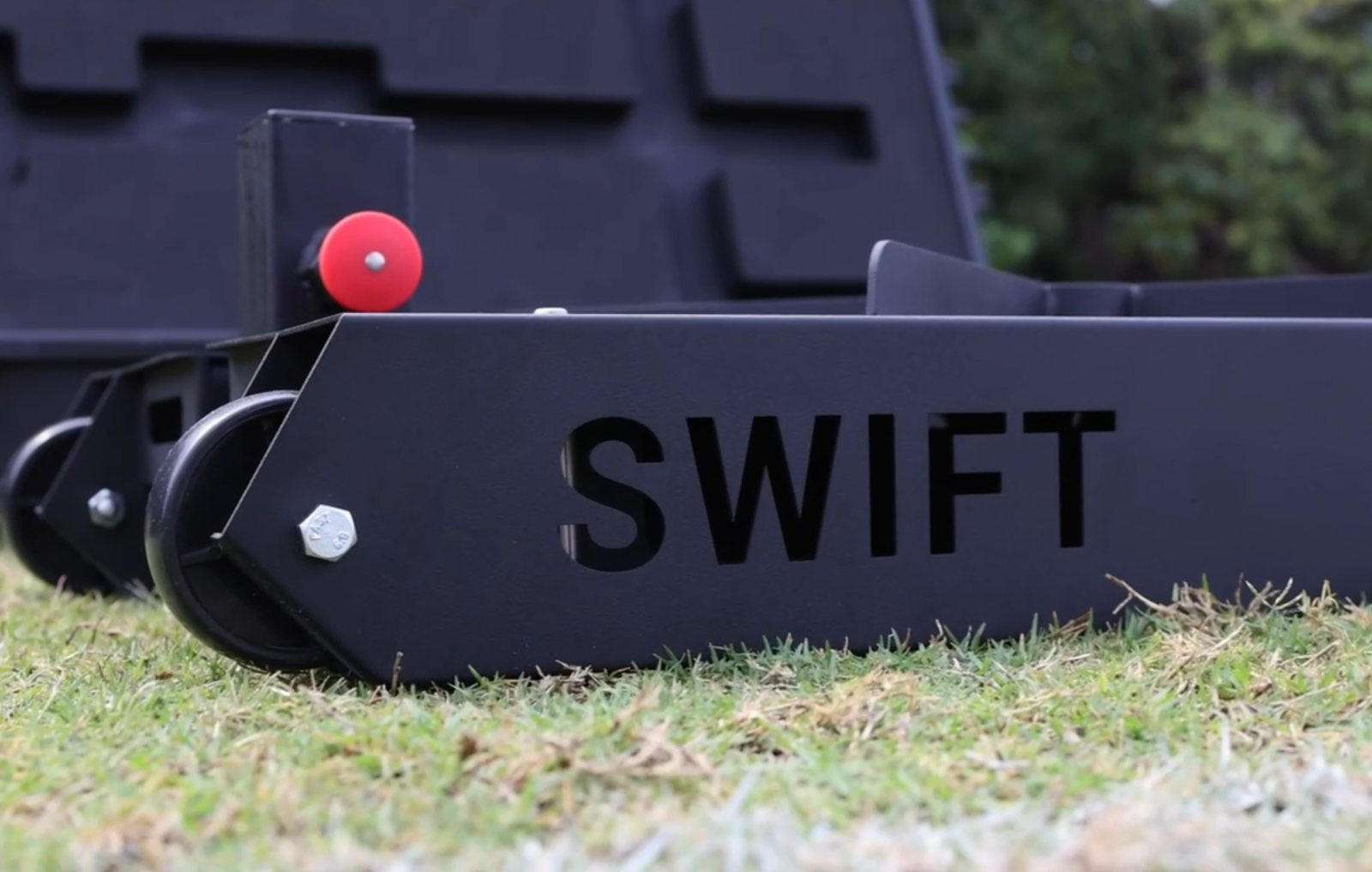
DynaSled is a friction-resistance sled, built by Swift Performance, that measures it. On a tethered pull it records the force in the tether and the speed of the sled through the run, and it measures the friction of the surface you are on. Run an athlete at a few loads and Swift Labs fits a force-velocity profile for that athlete on the sled. It takes plates like any other sled and can be used with a push handle or a tethered pull.
The sled shows you what happened. It does not write the session. What to do with the numbers is the coach's decision.
Getting one
DynaSled is leased from Swift Performance. Details are on the Swift site.
Dean Benton is paid a commission by Swift Performance when a DynaSled is leased using his code.
References
Cross MR, Brughelli M, Samozino P, Brown SR, Morin JB (2017). Optimal loading for maximizing power during sled-resisted sprinting. International Journal of Sports Physiology and Performance. pubmed.ncbi.nlm.nih.gov/28051333
Cross MR, Lahti J, Brown SR, et al. (2018). Training at maximal power in resisted sprinting: optimal load determination methodology and pilot results in team sport athletes. PLoS ONE 13(4): e0195477. doi.org/10.1371/journal.pone.0195477

A letter from Dean, every two weeks
One idea you can take to training. No spam, unsubscribe any time.
Sprint Mechanics is a Swift Performance platform. By signing up you agree that Swift Performance may email you the letter and news about DynaSled. Unsubscribe any time. Under 18? Ask a parent or guardian to sign up for you. Privacy, Terms, Disclosure.