Dean Benton has a world-class coaching skill set in developing running, specifically speed for field sports: the analysis of running, its interpretation and its application in coaching. Over the next few months he will share a series of short articles setting out his philosophies and methods for developing field sport speed and power.
Speed is often what defines key moments in field sports and distinguishes the average teams from the great teams. The key question coaches face, then, is: are we creating an environment that nurtures speed, or kills it? All too often we see athletes who fail to get faster as their careers progress or, typically, regress in their speed. In my experience, and that of many other coaches, the systematic progression of athletic and technical capabilities should see running-based sport athletes reach their speed potential in their late 20s or early 30s. It is up to us as coaches to create an environment to develop speed to its full potential.
We often place too great an emphasis on general running development, such as the 1.2km time trial (Bronco) and the 2km time trial. These tests are often seen as the ‘gold standard’ and lead indicator of running performance for field sports. However, in reality, these tests simply offer insights into general running capacity, which is primarily preparation for more specific qualities. General running capacity development is a means to an end – not an end in itself.
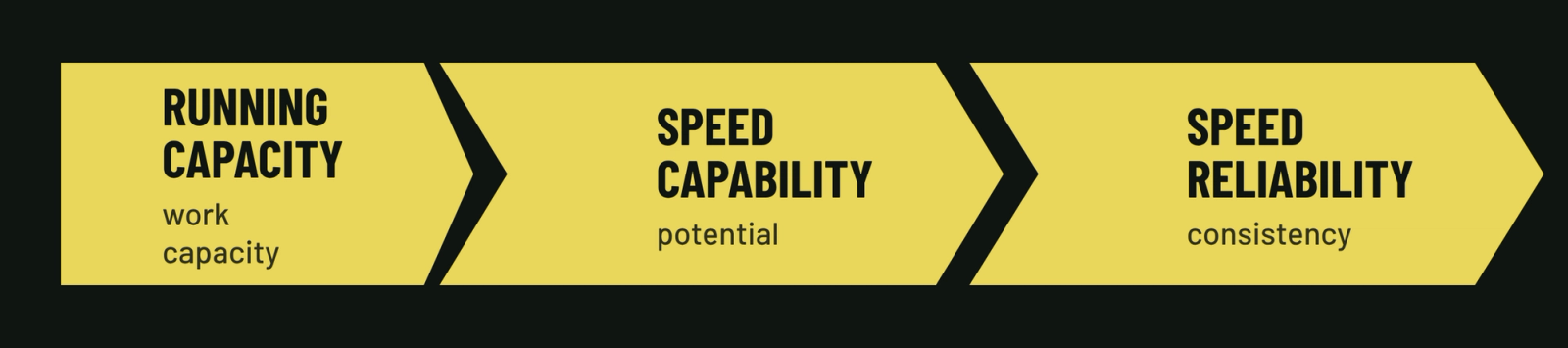
Defining speed and your speed limiters
For this discussion, the term speed is used generically for a quality that encompasses acceleration, deceleration, agility and maximum speed. To truly assess an athletic quality, we must test it in isolation, which is why the assessment of speed is undertaken without a ball and in a linear fashion. However, ultimately, the best evaluation of speed for field sports is its expression with key game actions – contextually – as part of the game plan, and whether it is maintained for the duration of the game.

Sprint Mechanics is a Swift Performance platform. Swift makes DynaSled, the friction-resistance sled Dean trains with.
See DynaSled at Swift →Dean Benton is paid a commission by Swift Performance when a DynaSled is leased using his code.